


Paris Haute Couture Week 2026 marks a turning point where craftsmanship meets code.
At Paris Haute Couture Week Spring 2026, Alexis Mabille delivered one of the most disruptive and visionary moments in recent couture history. Titled “The New Studio Hand Is an AI,” the designer’s latest collection redefined the runway by presenting an entire haute couture show created through artificial intelligence — without live models, without physical garments, and without traditional limitations.
The result was not a futuristic gimmick, but a compelling statement on how couture can evolve while preserving its soul.
Paris Haute Couture Week 2026 Enters the AI Era
Fashion insiders arriving at the historic Lido theater in Paris were met with an unexpected spectacle. Instead of models lining backstage, towering digital figures appeared on wraparound LED screens stretching across the venue’s dramatic 110-foot space.
At first, the visuals seemed like a pre-show installation. Slowly, realization set in — this was the runway itself.
For the first time in fashion history, a couture house presented an entire collection designed, visualized, and animated using artificial intelligence.
A Couture Show Without Physical Clothes
Alexis Mabille’s Spring 2026 couture collection existed entirely in the digital realm.

There were:
- No tangible garments on hangers
- No live fittings on models
- No traditional runway choreography
Instead, AI-generated models walked endlessly through the cinematic space, allowing guests to view the silhouettes from multiple angles — a virtual couture experience that felt immersive, fluid, and surprisingly intimate.
This innovative format challenged one of couture’s longest-held beliefs: that luxury must always be physically present to be experienced.
Why Alexis Mabille Chose Artificial Intelligence
Mabille was clear that artificial intelligence was not used as a shortcut.
“Usually, AI is used in a degenerative way — you feed it ideas and it creates for you,” the designer explained. “Here, we worked differently. It was like having an extra person in the studio.”
Rather than replacing creativity, AI functioned as a new atelier assistant — interpreting instructions, refining details, and learning couture codes over time.
Working for several months with French creative technology studio Glor’IA, Mabille trained the system repeatedly, noting that AI required patience similar to mentoring a junior craftsperson.
Inside the Alexis Mabille Spring 2026 Couture Collection
Despite its digital format, the collection remained unmistakably rooted in Parisian elegance and Mabille’s signature glamour.
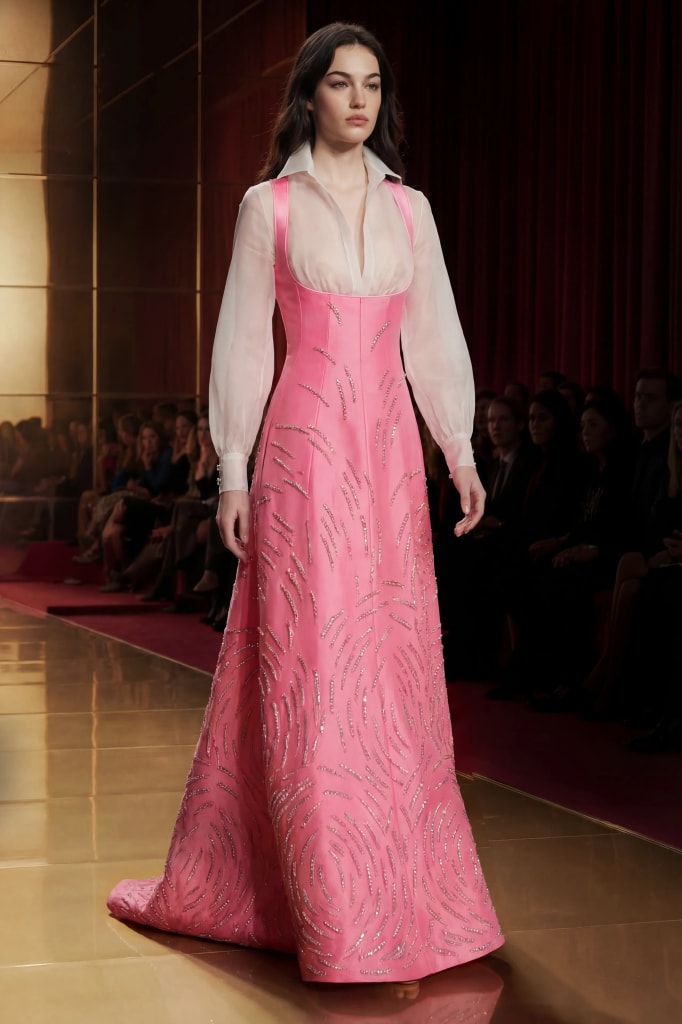
Key silhouettes included:
- A dramatic red crêpe frock coat with embroidered shawl collar
- A blush-pink tracksuit dress adorned with jeweled drawstrings
- Fluid evening shapes detailed with micro-pearl embroidery, rendered with hyper-realistic sheen
Every element — texture, weight, movement, and light reflection — was digitally constructed with couture-level precision.
The realism was so convincing that many guests described forgetting the garments were not physically present.
From Digital Couture to the Atelier
While the presentation was virtual, the craftsmanship behind it remains tangible.
Back in the Paris studio, toiles for each silhouette have already been developed, allowing the collection to transition from screen to salon for private client fittings.
Mabille compared the process to architectural walk-through simulations, commonly used in interior design — another discipline within his creative universe — where structures are perfected digitally before being built.
In this way, AI became a tool of foresight rather than fantasy.
A Runway Cast Beyond Reality
The emotional core of the show lay in its casting — even in pixel form.

- The opening look featured supermodel and longtime collaborator Diana Gartner, digitally recreated with striking accuracy.
- The finale belonged to Mabille’s mother, Mireille, who received a full digital makeover — transforming the closing moment into a personal tribute.
The gesture reinforced the idea that couture storytelling transcends physical presence.
Innovation, Not Cost Cutting
Amid growing debate around AI and labor, Mabille emphasized that the project was not driven by budget concerns.
Resources saved from not staging a traditional runway were reinvested into:
- A specialized team of up to 10 digital artists and technicians
- Advanced AI-generation platforms
- Months of testing, corrections, and retraining
The production proved as complex — and as costly — as a conventional couture show.
Why This Couture Moment Matters
The Alexis Mabille Spring 2026 couture show arrives at a moment when fashion is increasingly consumed through screens.
While some critics questioned whether couture can exist without physical garments, Mabille offered a timely reminder:
Haute couture has always been a laboratory for experimentation.
From hand embroidery innovations of the past to today’s algorithmic tools, couture has continuously evolved — not by rejecting tradition, but by expanding it.
When Craft Meets Code
Alexis Mabille Spring 2026 Couture stands as one of the most defining presentations of Paris Haute Couture Week 2026.
It challenges long-standing ideas of:
- What constitutes a runway
- How garments are designed
- Where craftsmanship truly begins
By welcoming artificial intelligence as a collaborator rather than a threat, Mabille has opened a new chapter in luxury fashion — one where heritage and technology exist side by side.
In Spring 2026, the couture atelier gained a new studio hand.
Not human.
But undeniably creative.
Live Your Dream of Billboards
We Connect Talent With Opportunity
BEFModels helps aspiring fashion models get noticed by promoting them online, connecting them with brands, and offering exciting events and collaborations.
Become a Model – Sign Up

