


Bhavitha Mandava has made history. The 26-year-old Indian model is the first Indian model to appear solo on the cover of British Vogue. It’s a landmark achievement in a global fashion landscape where South Asian faces have been seen before, but rarely fronted such an influential fashion title on their own.
Her March 2026 cover, photographed by Oliver Hadlee Pearch, captures Mandava mid-laughter — radiant, unguarded and self-assured. In her editor’s letter, Chioma Nnadi describes her rise as a “fashion fairy tale,” writing that she was “scouted on a New York subway platform less than two years ago — and now she’s fronting one of the most influential fashion titles in the world.”
This is not just a cover. It is a cultural reset.
From Hyderabad to the Global Runway
Mandava was born and raised in Hyderabad and moved to New York to pursue architecture before modelling reshaped her trajectory. Reflecting on her unexpected discovery, she has said, “I never imagined modelling would be my path. I moved to New York for architecture — fashion found me when I wasn’t even looking for it.”
Within months of being scouted, she was walking for luxury powerhouses like Bottega Veneta and Dior — a meteoric ascent by any standard.
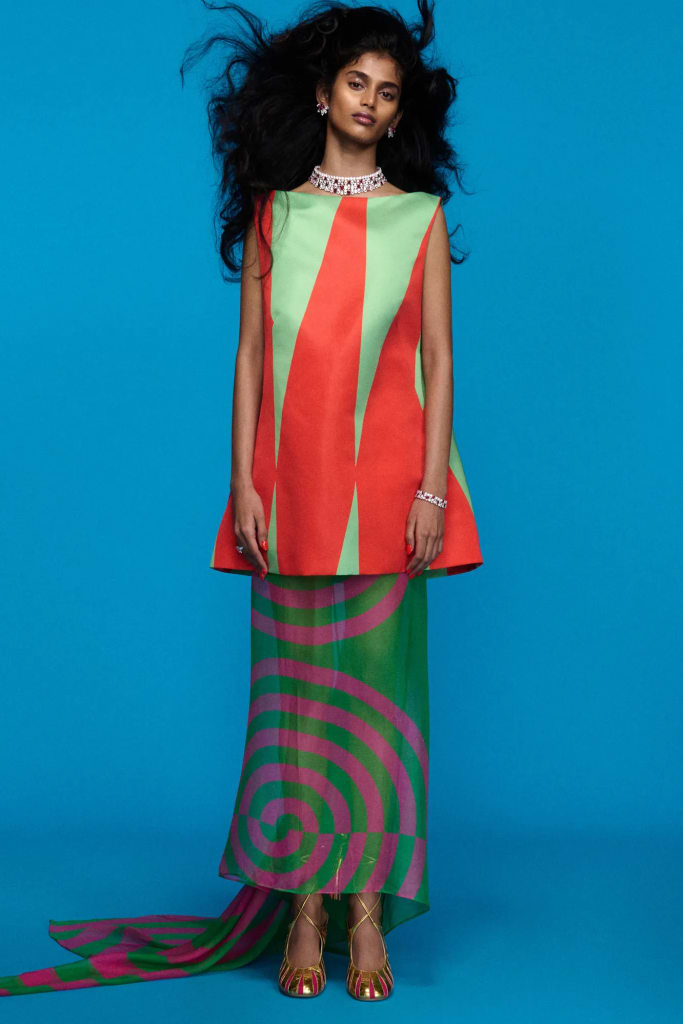
When Matthieu Blazy staged Chanel’s Métiers d’Art show in 2026, Mandava became the first Indian model to open a Chanel show. Speaking about that moment, she shared, “Walking out first for Chanel felt surreal. My career began underground, on a subway platform — and suddenly I was opening one of the most iconic houses in fashion.”
The symbolism was unmistakable.
Why British Vogue Still Carries Institutional Weight
British Vogue is more than a glossy monthly publication. It remains a cultural barometer that helps define global beauty standards and aspirational narratives.
Historically, South Asian representation in such spaces has often leaned on celebrity power — from Priyanka Chopra Jonas to Simone Ashley. Mandava’s cover is distinct because she is positioned as a fashion model first, not a crossover star.
In her interview, Mandava addresses the Western gaze and long-standing assumptions about beauty. “There are quiet rules about who gets to be seen as traditionally beautiful,” she notes. “I’ve felt those assumptions — and I’ve also felt them shifting.”
She has spoken about receiving messages from young women across India and the diaspora. “When girls tell me they see themselves in me, that’s when it feels bigger than fashion,” she says. “It feels like possibility.”
The joy captured on the cover is intentional. “That laughter wasn’t staged,” she explains. “It was relief, pride — and gratitude.”
Representation and Its Complexities
Fashion’s relationship with diversity has not always been straightforward. As global brands expand into emerging markets like India, conversations continue around whether inclusion reflects structural transformation or strategic growth.

Yet visibility — however layered — reshapes imagination.
Mandava’s cover does not frame Indianness as spectacle. She is styled not as an exotic aside, but as high fashion’s present tense. That reframing is subtle but powerful.
“I don’t want to be the exception,” Mandava says. “I want to be part of a wave.”
Her achievement builds upon those who came before. South Asian models such as Neelam Gill and Pooja Mor carved pathways on international runways, while global covers featuring Indian actors helped normalise South Asian presence in Western fashion spaces.
Mandava’s moment sits within that lineage while marking a distinct first — an Indian model, solo, on the cover of British Vogue.
A Cultural Marker, Not Just a Milestone
In a media landscape saturated with fleeting viral triumphs, this cover carries institutional weight. It signals that Indian fashion talent is not merely participating in the global industry, but shaping its visual language.
For young girls in Hyderabad, Mumbai, London or New York, that shift matters deeply. Representation in fashion is not only about being seen; it is about who is allowed to embody aspiration.
As Mandava puts it:
“If even one girl looks at this cover and thinks, ‘Why not me?’ — then it means everything.”
Bhavitha Mandava’s British Vogue cover is a personal milestone. But it is also a cultural marker — proof that the centre of fashion is slowly, visibly widening.
Live Your Dream of Billboards
We Connect Talent With Opportunity
BEFModels helps aspiring fashion models get noticed by promoting them online, connecting them with brands, and offering exciting events and collaborations.
Become a Model – Sign Up

