

As Raw Mango approaches its eighteenth year, Sanjay Garg arrives at London Fashion Week with quiet certainty rather than spectacle. The designer is not interested in reshaping his vocabulary for a global stage — nor translating Indian craft into something more palatable for Western audiences. For Garg, geography holds little authority over design.
“Presenting in London is as good as presenting in Kanpur,” he says simply. The sentiment feels less like defiance and more like clarity. Fashion, in his world, is defined by integrity of work, not the coordinates of its audience.
This philosophy anchors Raw Mango’s latest collection, It’s Not About the Flower — a title that reads like a meditation rather than a statement.
The Poetry of Plurality
In much of South and Southeast Asia, a single flower rarely carries meaning on its own. Emotion gathers through repetition — through strings, clusters, and accumulation. India is a culture of garlands: marigold chains suspended at weddings, jasmine loops woven into ritual, tuberose strands marking devotion, celebration, and remembrance alike.

The garland, humble and omnipresent, becomes Garg’s central form. Familiar to the point of invisibility, it moves fluidly between the sacred and the everyday — draped across idols, exchanged in ceremonies, hung in homes, and renewed endlessly.
Here, it is neither accessory nor embellishment. It becomes structure.
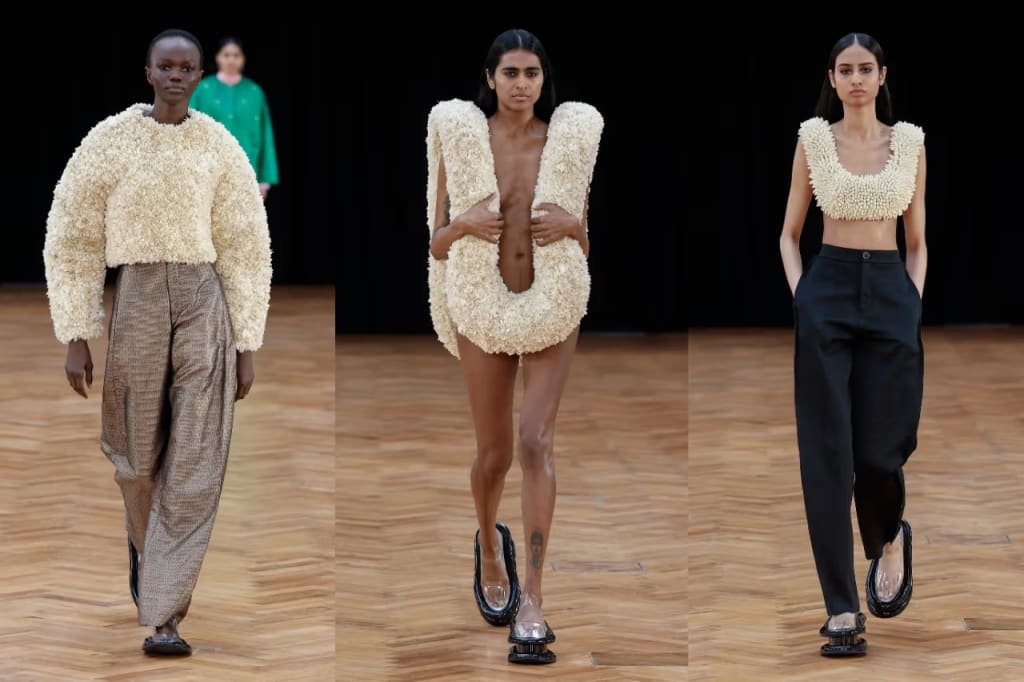
“I wanted to show how a three-dimensional garland could become the body itself,” Garg explains.
When Ornament Turns Architectural
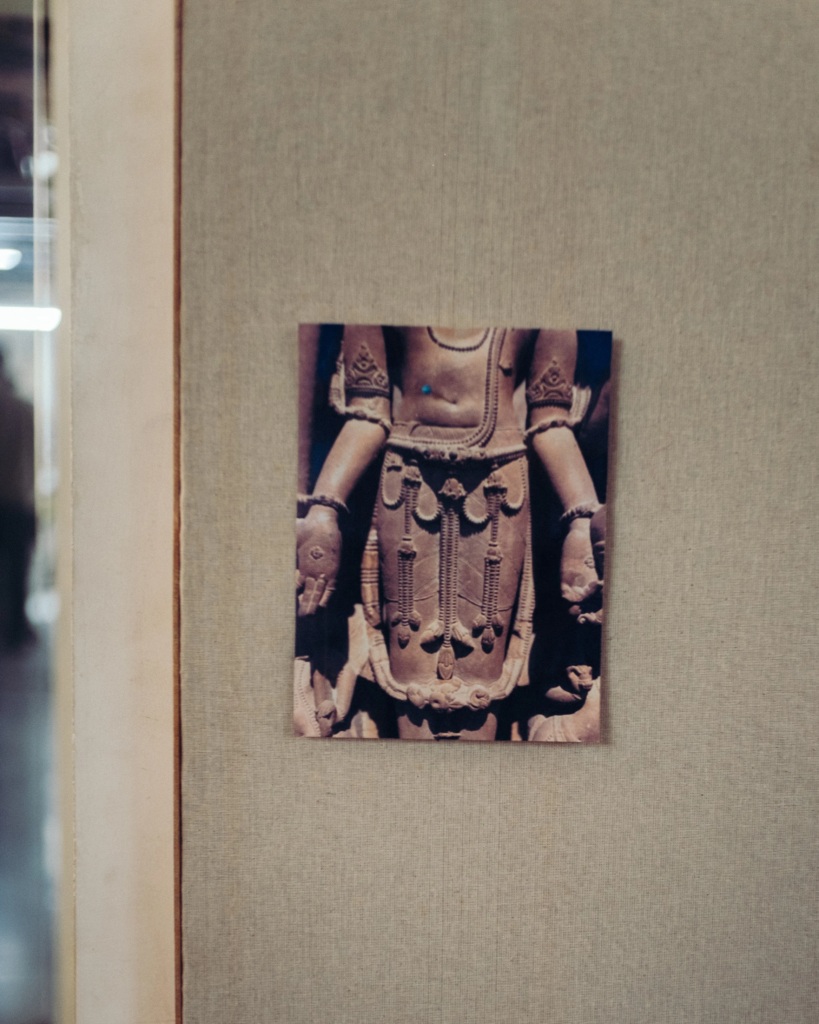
On the runway, floral forms refuse passivity. They arc across torsos, coil around shoulders, and interrupt silhouettes with sculptural intent. The reference stretches across centuries — from ancient temple carvings where stone garlands cascade across sculpted chests to the bundled potlis of fresh flowers found in markets across the subcontinent.
Craftsmanship remains central, yet deliberately restrained. Jasmine-like blooms are laser-cut from silk and assembled by hand; rajnigandha forms are rolled into delicate, paper-like constructions before being individually embroidered into larger compositions. Each flower exists as part of a collective — echoing the cultural symbolism that inspired it.

The effect is tactile yet controlled, romantic yet architectural.
A Rejection of Excess
Garg has long resisted the global tendency to define Indian fashion through opulence alone. Too often, he argues, garments are evaluated by the density of embroidery or the number of artisan hours invested rather than their aesthetic intelligence.
The collection moves away from ornamental excess. Embroidery remains light, almost restrained, allowing the weave to breathe and construction to take precedence. Surfaces feel intentional rather than overwhelming — a quiet recalibration of how Indian textiles are perceived on international runways.
Here, craftsmanship whispers instead of announcing itself.
Between Sculpture and Ease
Some silhouettes venture into sculptural territory, incorporating padding and welded iron rings — an evolution of ideas first explored in Raw Mango’s earlier Children of the Night. These pieces hold their own architecture, standing slightly apart from the body.
Others return to familiarity: fluid drapes, softened tailoring, garments that move instinctively with the wearer. Across both expressions, the garland dictates placement and proportion, shaping how fabric occupies space.
The result is a collection balanced between experiment and wearability — intellect grounded in intimacy.
A Study in Monochrome
Perhaps the collection’s most unexpected gesture lies in its palette. Instead of the saturated hues often anticipated from Indian fashion, Garg turns toward black and white.
The restraint sharpens focus on silhouette and texture. Into this monochromatic landscape arrive sudden flashes of green, lemon yellow, and rose pink — colours drawn directly from flower markets. Garg describes them as “visual sorbets,” brief moments of brightness that punctuate the visual rhythm without overwhelming it.
It is colour used with intention rather than abundance.
Designing Without Translation
Placed within the framework of London Fashion Week, Raw Mango’s presentation resists easy categorisation. Garg neither amplifies cultural markers nor softens them for international readability. The work remains unchanged — rooted in its own logic.
Over the years, the label has found resonance far beyond India, worn by diplomats, artists, and cultural figures across continents. London, then, becomes less a debut and more a continuation of an ongoing conversation.
There is, Garg insists, no perfect timing for such moments. “It’s just happening now.”
Fashion as Cultural Archive
At its core, the collection gestures toward something larger than fashion itself. India, Garg reflects, is an expansive repository of stories — languages, traditions, communities, and histories layered in complex coexistence. Textiles become a medium through which these narratives surface, not as singular identities but as plural voices.
Indian design, in this context, resists uniformity. Its strength lies precisely in its multiplicity.
Since its founding in 2008, Raw Mango has cultivated an audience deeply attuned to material and meaning. That audience has grown across generations and geographies, yet Garg remains less interested in defining who wears the clothes than in refining the language behind them.
The Garland Travels
In It’s Not About the Flower, an everyday object is reimagined with profound subtlety. The garland — handled, replaced, and remade for centuries — shifts from ritual adornment to contemporary form.
On a London runway, thousands of miles from the markets and ceremonies that inspired it, the symbolism remains intact.
The flower becomes part of a string.
The string becomes structure.
And the structure moves forward, carrying tradition without nostalgia — only evolution.

